
Two years ago today, I spent my last partial day in Stockholm and in the evening boarded my first overnight cruise for Helsinki, Finland.
For a review, see these posts, all written about six weeks after the fact.
Friday, September 11, 2009

Thursday, September 10, 2009
Walkin' In Memphis
 After lunch on the day we visited the Pyramids, we drove the 10 miles or so south of Giza to the ancient town of Memphis. Memphis was likely founded 5000 years ago upon the unification of the two kingdoms of Upper (Southern) and Lower (Northern) Egypt*. It was the capital of Ancient Egypt during the Old Kingdom (roughly 2630 BC - 2150 BC), during which the Great Pyramid Pharaohs reigned, and for periods during the New Kingdom a millenium later.
 Evidently, a Memphian temple to the God Ptah gave us our name for Egypt. The Ptolemaic Egyptologist Manetho transliterated the Egyptian phrase for "Place of the life-force of Ptah" into the Greek syllables "Ai-gy-ptos", and that name stuck for the country as a whole.
 The main site we visited in Memphis was an open air museum. It has many statues, including a sphinx. The big draw, however, is the 30 ft. alabaster Colossus of Ramses II, found in 1820, which is located in a small building on the site. For more of my pictures of the open air museum, click here.
*"Upper" and "Lower" Egypt are in reference to the flow of the Nile. The sources of the Nile -- the Ehtiopian Plateau (Blue Nile) and the Central African highlands (White Nile) -- are south of Egypt. So Upper Egypt is south of Lower Egypt (the Nile Delta).
Monday, September 7, 2009
I, Sphinxster
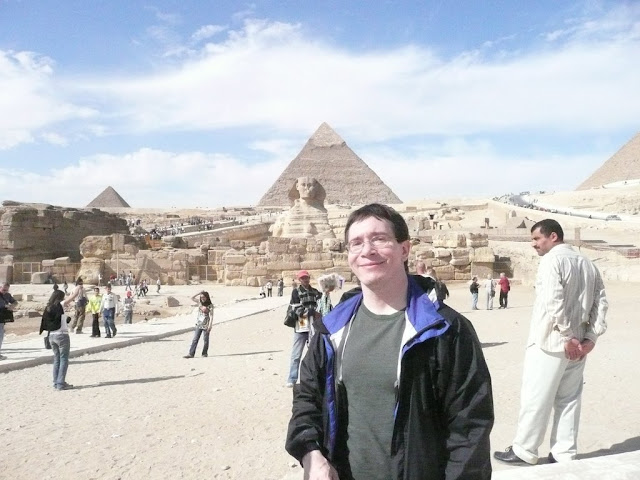
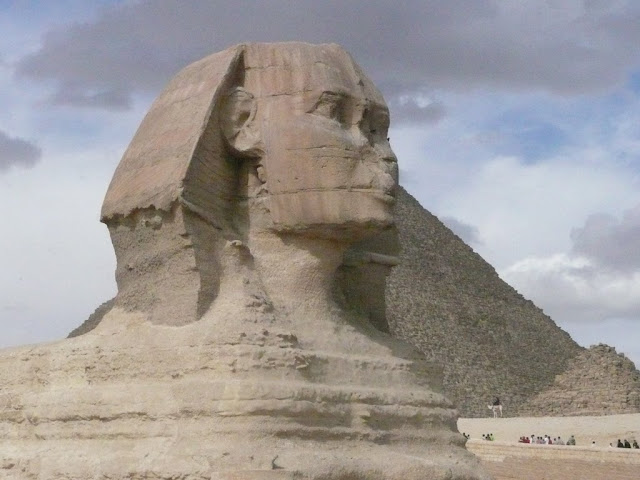 Right after the camel ride, we got back on the van and went to the edge of the Giza necropolis to see the Sphinx. The Sphinx is somewhat of a historical mystery it seems. First, "Sphinx" is somewhat of a misnomer; we still don't know what contemporaneous Ancient Egyptians (that is, Egyptians roughly of Khufu's era, around 2500 B.C.) called it. "Sphinx"* is what much later classical Greeks called it. They had their own story about a lion-human hybrid. In the Greek myth, the Sphinx had wings and a women's head, whereas the Egyptian Sphinx has a male head with Pharaonic headdress and no wings. But close enough, I guess.**
 Anyway, no one has been able to determine when the Sphinx was built. The consensus is that it was built by Khafre, the Pharaoh who built the second largest of the Great Pyramids. But there is no direct mention or evidence of the statue that links it to that period. This lack of evidence is why we don't know that Egyptians of that era named it. Some past and present Egyptologists have claimed that the Sphinx predates Khufu's era and may have been excavated/restored around 2500 B.C., rather than constructed then.
 Over a millennium later in 1400 B.C., it was buried up to the shoulders in sand, and the Pharaoh Thutmose IV restored it during his reign. Ramses II may have restored it again during his reign over a century later. It may be during this era that the ceremonial Pharaonic beard was added, which later fell off.
The Gizan Great Sphinx may be superlative in a few senses, but it is not the only sphinx in Egypt. In fact, at some point sphingine imagery became somewhat common; there's a roughly mile-long road between the Luxor and Karnak temples whose sides were lined with hundreds of smaller sphinges, many of which still survive.
Oh, and about the Sphinx's missing nose: I've always heard it was blown off by Napoleon's troops, who used it for target practice. But evidently that's a myth, since sketches from the mid-1700's show the nose already missing.
For more of my pictures from the Sphinx, click here.
* Sphinx comes from the Greek verb to strangle, the Greek Sphinx's method of dispatching those who could not answer her questions. As such, it's etymologically related to the word sphincter.
** And no worse than Egypt, essentially the Greek name for the country, which has little resemblance to the terms the ancient or modern Egyptians used for it.
Sunday, September 6, 2009
Camel Ride: The Sequel
 Background: earlier in November in a parking lot outside the Roman theater at Aspendos, fellow Turkey tourer Brian and I paid to take camel rides; we each took pictures of the other during our few-minute rides in circles on a level parking lot.
 That was before I knew that each person on the Egypt tour got to take a camel ride by the Pyramids. So, on the way from the Pyramids to the Sphinx, the tour stopped to take a group camel ride.
This time, the trip was significantly longer; the handlers led us a hundred yards or so down a small dune and then back up again for a trip of 10-15 minutes. Before Turkey, I'd never ridden a large animal. This time, I noticed that the saddle only had one stirrup; that led me to think of the severe ankle damage I'd likely sustain if I fell off. The inclined path didn't help either. The desert is somewhat rocky and uneven and it seemed that my camel kept stumbling and lurching a little as it went up and down, which made me more nervous. Much of the time, I had one hand on the reins and another hand on the post of the saddle behind me to secure myself. This awkwardness amused some of my fellow riders.
Another portion of camel rides that are somewhat disconcerting is that camels are too tall to easily mount or dismount while they are standing; so they have to crouch down for the riders. A standing camel, though, doesn't really want to go back down on the ground. So the handlers have thick sticks with which they strike the camel behind its front knees. This induces the camel to quickly kneel on its front legs and then more slowly lower its back legs. So the beginning and end of the rides are somewhat lurchy and I was never sure how the camel was going to react to this method of correction.
Here are some more pictures from my Giza camel ride.
Pyramid Construction Methods
When we visited the Pyramids, one idea that our guide Ahmed tried to disabuse us of was that the Pyramids were built by slave labor. He stated that some of the brute force of moving the multi-ton stone blocks could be done by "throwing people" at the problem. But, even in that case, there would be a need for careful, knowledgeable people around to set up and supervise the hauling, lest people be crushed, maimed, and killed on a regular basis.
Ahmed told us that there was archeological evidence that large teams (thousands, if not tens of thousands) of skilled artisans were employed by the Pharaohs to quarry and cut the blocks to exacting specifications. These people were well-compensated and probably carved the stones out of a sense of pride and something akin to a combination of patriotism and religious duty in order to give their God-King as perfect monument as possible. Ahmed said the precision with which the blocks fit together on all faces really couldn't be explained by masses of slaves chiseling at hunks of granite and limestone.
Here's a general wikipedia article on Pyramid construction.
On the subject of moving the stones into place as the Pyramid was constructed, many theories have been advanced over the years from sensible applications of physics and engineering such as ramps, levers, and logs to silly pseudo-scientific blather like aliens did it. One recent intriguing theory that Michelle's brother Troy told us about this winter involves the use of a spiraling ramp built around the periphery of the pyramid as the pyramid is built up. This idea, advanced by French architect Jean-Pierre Houdin and his father, says that a large external ramp was used to lay the foundation and then was deconstructed and used to build the internal ramp system. The idea is that a solely external ramp would have to be either too long or too steep, once the pyramid reached a certain height. This theory still seems to be controversial, but there is evidence of such a spiraling ramp structure within the Great Pyramid. For more, see this 2007 article by Egyptologist Bob Brier.
Another subject that comes up when discussing the Pyramids concerns the sheer size of the stones used. According to these wikipedia articles, the average weight of the 2.3 million stones that comprise the Great Pyramid is 5000 pounds and the largest stones weigh over 100,000 pounds. Given that the Pyramids were constructed over 4500 years ago, it's a question of how the Egyptians managed to move such massive blocks. Modern engineers don't know exactly how to duplicate this feat with the technology available to the Ancient Egyptians.
In the past year, I've learned of how Wally Wallington, a retired construction worker, uses basic physics to move seemingly impossibly heavy objects by himself with little to moderate effort:
He thinks techniques like these are all that are required to build ancient massive structures such as the Pyramids or Stonehenge. Watching him whip around multi-ton blocks, I'm inclined to agree. Probably since the Ancient Egyptian civilization was centered around building massive stone structures like the Pyramids, the Sphinx, and various temples, they became quite clever and adept at moving huge stones around over the centuries. And, once the building of these monuments stopped being an integral part of the culture, these techniques were forgotten. As better machines were invented in modern times, the need to rediscover these techniques faded and now they can seem pretty amazing.
Mr. Wallington's web site is a little clunky, but has some interesting clips and explanation. I'm almost tempted to buy his DVD.
I also wonder why his site doesn't seem to have been updated since 2007. I hope he didn't get an unhappy lesson about exactly how much inertia a 10-ton concrete block has.
H/T: Skeptoid author Brian Dunning
Ahmed told us that there was archeological evidence that large teams (thousands, if not tens of thousands) of skilled artisans were employed by the Pharaohs to quarry and cut the blocks to exacting specifications. These people were well-compensated and probably carved the stones out of a sense of pride and something akin to a combination of patriotism and religious duty in order to give their God-King as perfect monument as possible. Ahmed said the precision with which the blocks fit together on all faces really couldn't be explained by masses of slaves chiseling at hunks of granite and limestone.
Here's a general wikipedia article on Pyramid construction.
On the subject of moving the stones into place as the Pyramid was constructed, many theories have been advanced over the years from sensible applications of physics and engineering such as ramps, levers, and logs to silly pseudo-scientific blather like aliens did it. One recent intriguing theory that Michelle's brother Troy told us about this winter involves the use of a spiraling ramp built around the periphery of the pyramid as the pyramid is built up. This idea, advanced by French architect Jean-Pierre Houdin and his father, says that a large external ramp was used to lay the foundation and then was deconstructed and used to build the internal ramp system. The idea is that a solely external ramp would have to be either too long or too steep, once the pyramid reached a certain height. This theory still seems to be controversial, but there is evidence of such a spiraling ramp structure within the Great Pyramid. For more, see this 2007 article by Egyptologist Bob Brier.
Another subject that comes up when discussing the Pyramids concerns the sheer size of the stones used. According to these wikipedia articles, the average weight of the 2.3 million stones that comprise the Great Pyramid is 5000 pounds and the largest stones weigh over 100,000 pounds. Given that the Pyramids were constructed over 4500 years ago, it's a question of how the Egyptians managed to move such massive blocks. Modern engineers don't know exactly how to duplicate this feat with the technology available to the Ancient Egyptians.
In the past year, I've learned of how Wally Wallington, a retired construction worker, uses basic physics to move seemingly impossibly heavy objects by himself with little to moderate effort:
He thinks techniques like these are all that are required to build ancient massive structures such as the Pyramids or Stonehenge. Watching him whip around multi-ton blocks, I'm inclined to agree. Probably since the Ancient Egyptian civilization was centered around building massive stone structures like the Pyramids, the Sphinx, and various temples, they became quite clever and adept at moving huge stones around over the centuries. And, once the building of these monuments stopped being an integral part of the culture, these techniques were forgotten. As better machines were invented in modern times, the need to rediscover these techniques faded and now they can seem pretty amazing.
Mr. Wallington's web site is a little clunky, but has some interesting clips and explanation. I'm almost tempted to buy his DVD.
I also wonder why his site doesn't seem to have been updated since 2007. I hope he didn't get an unhappy lesson about exactly how much inertia a 10-ton concrete block has.
H/T: Skeptoid author Brian Dunning
Khufu Boat Museum
 In 1954, a disassembled ship was found buried in a pit by the side of the Great Pyramid. The boat was apparently a ceremonial craft to help Khufu in his afterlife. Khufu may also have used it on the Nile to visit religious places during his life.

For a decade following its discovery, the boat was carefully reassembled. Now, there is a museum right by the Great Pyramid that houses the boat and other artifacts unearthed along with it. Here are my pictures from the Khufu Ship Museum.
Estonian Pyramid Connection

While looking over this list of the tallest historical structures, I realized I had visited another one roughly six weeks before seeing the Pyramids.
The Great Pyramid remained the tallest until 1311 when the Lincoln Cathedral was finished in England. I've never been to England, so I didn't see that. But the Lincoln Cathedral's successor was St. Olaf's Church in Tallinn, Estonia, which was the tallest structure from 1549-1625, when its spire burned down. Its been rebuilt at least once now, but is currently over 100 ft shorter than when it reigned.

For more pictures of St. Olaf's, including dozens of pictures of Tallinn from its observation deck, go here.
Subscribe to:
Posts (Atom)