
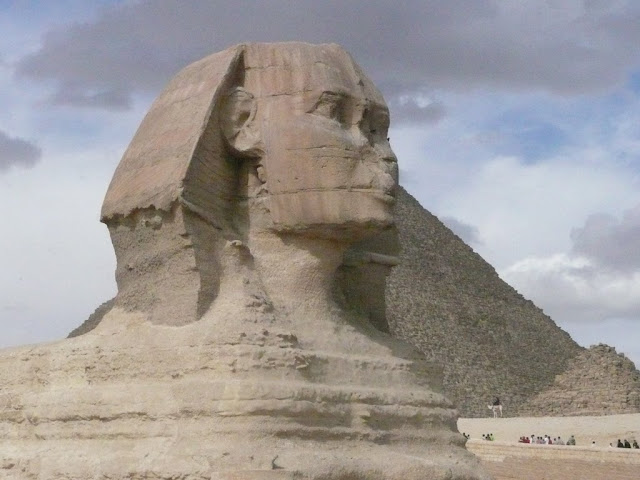
 Right after the camel ride, we got back on the van and went to the edge of the Giza necropolis to see the Sphinx. The Sphinx is somewhat of a historical mystery it seems. First, "Sphinx" is somewhat of a misnomer; we still don't know what contemporaneous Ancient Egyptians (that is, Egyptians roughly of Khufu's era, around 2500 B.C.) called it. "Sphinx"* is what much later classical Greeks called it. They had their own story about a lion-human hybrid. In the Greek myth, the Sphinx had wings and a women's head, whereas the Egyptian Sphinx has a male head with Pharaonic headdress and no wings. But close enough, I guess.**
 Anyway, no one has been able to determine when the Sphinx was built. The consensus is that it was built by Khafre, the Pharaoh who built the second largest of the Great Pyramids. But there is no direct mention or evidence of the statue that links it to that period. This lack of evidence is why we don't know that Egyptians of that era named it. Some past and present Egyptologists have claimed that the Sphinx predates Khufu's era and may have been excavated/restored around 2500 B.C., rather than constructed then.
 Over a millennium later in 1400 B.C., it was buried up to the shoulders in sand, and the Pharaoh Thutmose IV restored it during his reign. Ramses II may have restored it again during his reign over a century later. It may be during this era that the ceremonial Pharaonic beard was added, which later fell off.
The Gizan Great Sphinx may be superlative in a few senses, but it is not the only sphinx in Egypt. In fact, at some point sphingine imagery became somewhat common; there's a roughly mile-long road between the Luxor and Karnak temples whose sides were lined with hundreds of smaller sphinges, many of which still survive.
Oh, and about the Sphinx's missing nose: I've always heard it was blown off by Napoleon's troops, who used it for target practice. But evidently that's a myth, since sketches from the mid-1700's show the nose already missing.
For more of my pictures from the Sphinx, click here.
* Sphinx comes from the Greek verb to strangle, the Greek Sphinx's method of dispatching those who could not answer her questions. As such, it's etymologically related to the word sphincter.
** And no worse than Egypt, essentially the Greek name for the country, which has little resemblance to the terms the ancient or modern Egyptians used for it.


