Sunday, September 6, 2009

Khufu Boat Museum

In 1954, a disassembled ship was found buried in a pit by the side of the Great Pyramid. The boat was apparently a ceremonial craft to help Khufu in his afterlife. Khufu may also have used it on the Nile to visit religious places during his life.


For a decade following its discovery, the boat was carefully reassembled. Now, there is a museum right by the Great Pyramid that houses the boat and other artifacts unearthed along with it. Here are my pictures from the Khufu Ship Museum.

Estonian Pyramid Connection


While looking over this list of the tallest historical structures, I realized I had visited another one roughly six weeks before seeing the Pyramids.

The Great Pyramid remained the tallest until 1311 when the Lincoln Cathedral was finished in England. I've never been to England, so I didn't see that. But the Lincoln Cathedral's successor was St. Olaf's Church in Tallinn, Estonia, which was the tallest structure from 1549-1625, when its spire burned down. Its been rebuilt at least once now, but is currently over 100 ft shorter than when it reigned.


For more pictures of St. Olaf's, including dozens of pictures of Tallinn from its observation deck, go here.

Friday, September 4, 2009

Pyramids

Early on the second morning of our tour, we went down the road from our Gizan hotel to the site of the Pyramids. The Pyramids are essentially mausoleums. Each of the three contained the mummified corpse of a Pharaoh along with all the treasures and possessions someone of his standing would need in the afterlife. The largest (the Great Pyramid) was built by Khufu (aka Cheops), the next largest by his son or grandson Khafre, and the smallest by Menkaure. The afterlife was a major concern in Egyptian theology, so the final resting place of the Pharaoh was a major public project throughout his reign. Although it is smaller in height and in volume, Khafre's pyramid (the one with the remnants of its outer casing still visible around the top) is built on higher ground and so looks taller than the Great Pyramid that Khufu built. Since the Egyptians associated the setting sun metaphorically with the end of life, Giza is on the west side of the Nile.

The Gizan Pyramids were one of the seven wonders of the ancient world and are the only still in existence today. Although the Great Pyramid was built approximately 4,500 years ago, it was the tallest man-made structure until the construction of the Lincoln Cathedral in England was completed in 1311 AD. Their size made them prime targets, though; these and later smaller pyramids were all looted. Future generations of Pharaohs moved their tombs to underground complexes in the Valley of the Kings.

Besides the three main pyramids, there are a few much smaller pyramids that contain the remains of the queens of the Pharaohs. Additionally there are rectangular mounds called mastabas that mark the underground burial chambers of nobles. There are also underground pits that house disassembled ceremonial boats. One of these was unearthed in 1954, reassembled painstakingly for a decade, and is now on display in a museum that abuts the Great Pyramid. This Wikipedia image shows the layout of the Gizan Pyramid site.

For more of my pictures of the Giza Pyramids, click here.

Khan El Khalili Bazaar/Al Azhar


At the end of the first day of our Egypt tour, we visited the Khan El Khalili Bazaar, which was founded in 1382. This was probably my least favorite part of the Egypt tour. I wasn't interested in buying anything and the narrow streets of the bazaar crowded with people didn't really interest me. I wandered around the streets a little, but it was difficult to take pictures without feeling in the way and the bazaar is an area they warned us about pickpockets and thefts. In short, I was tired and there wasn't much for non-shoppers to do to be entertained.

Of more interest to me was Al Azhar University (at left of picture), which is directly across the street from one end of the bazaar. I would have much preferred to go on a tour of the university and mosque. Al Azhar was founded in 975 AD, is the second oldest degree-granting university currently in existence, and still serves the primary site in the world for the study of Arabic literature and Sunni Islam.

Here are the rest of my pictures from the bazaar area.

Call the Copts!

The Copts are an ancient sect of Christians that formed in Egypt in the first century AD when Egypt was under Roman control. They had their own language and script (Coptic), evolved from the language and hieroglyphs of the ancient Egyptians. In the 7th century, Islam came to Egypt and became the dominant religion. Coptic Egyptian was still the main spoken language for another 300 years, but gradually Arabic replaced Coptic. Now there are only a few hundred speakers since a revival of the language in the 19th century.


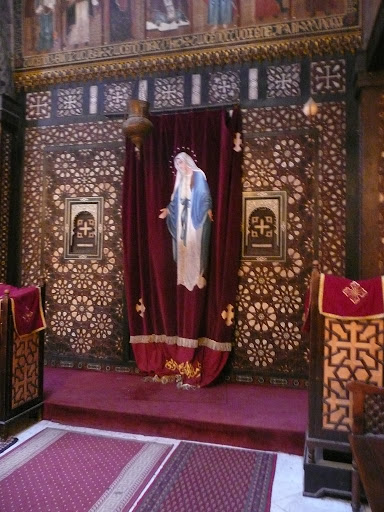
The most famous Coptic church in Egypt is the Hanging Church in Cairo, which my tour visited on our first afternoon. On our short walk to the church, two of our tour members separated from the group, causing a little stir. As I remember, we didn't find them until after we left the church.

Here are some more photos from my visit to the Hanging Church.

Thursday, September 3, 2009

Cairo Citadel/Mohammed Ali Mosque


On our first day, our first stop of the morning after crossing to the east side of the Nile from Giza was at the Mohammed Ali Mosque. This mosque, which was built by Mohammed Ali in the mid-19th century, is housed in a much older structure: the Cairo Citadel, the construction of which was started by Salah Ad-Din (Saladin) in the late 12th century. Parts of the citadel afford a great view of the sprawl of downtown Cairo.

On the subject of Saladin: You've likely heard that there's a lot of tension between Arabs and Kurds in Iraq and also Turks and Kurds. (The Kurdish terrorist organization PKK frequently kills Turkish troops near the border with Iraq/Kurdistan; Turkey made a small incursion into Kurdistan in retalliation to one such attack while I was in Istanbul.) As it turns out the great Muslim warrior and vanquisher of the Crusaders Saladin was a Kurd himself. I wonder if his heritage gets downplayed in modern Islamic history classes or if he's seen as an exceptional "good Kurd".


Here are some more of the pictures I took of the mosque and citadel.

Cairo


Here are a few pictures taken through the window of our van while riding between tourist sites around Cairo in November 2007.